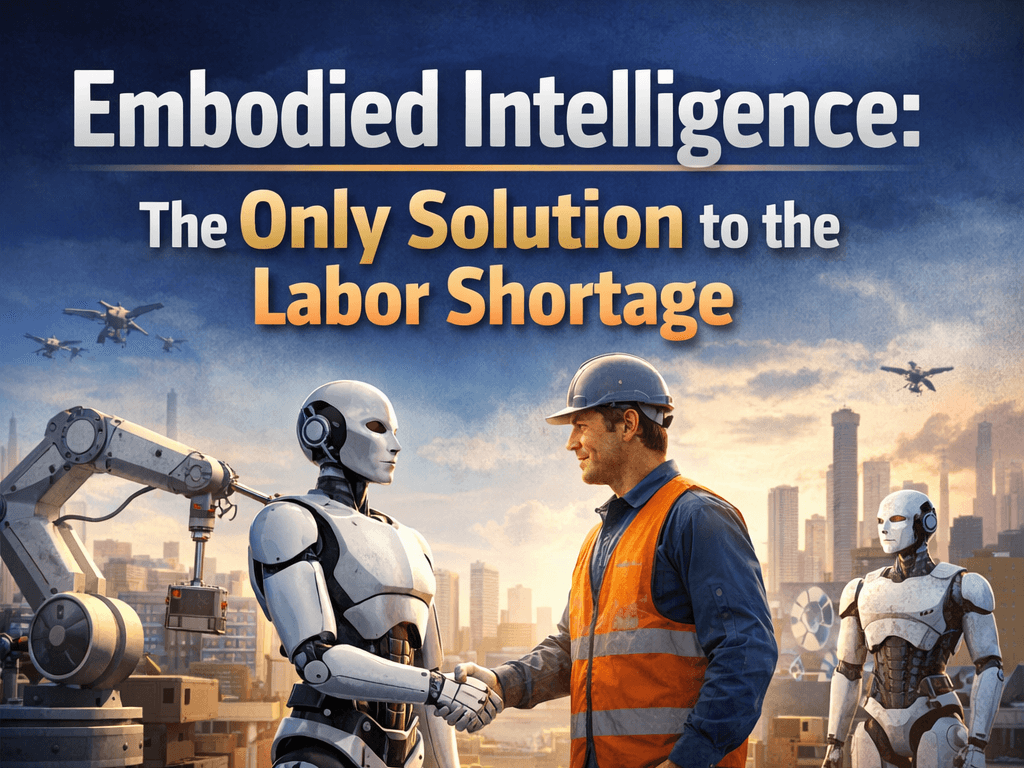
The global labor shortage is no longer a temporary economic anomaly. It is a structural, demographic reality that will define the next several decades of economic development. Across advanced economies, labor supply is shrinking due to aging populations, declining birth rates, and reduced immigration. At the same time, demand for labor—especially in manufacturing, logistics, healthcare, and infrastructure—continues to rise.
Traditional solutions such as wage increases, immigration reform, and workforce retraining are necessary, but insufficient. They cannot close the gap at the scale and speed required. The only solution that is fundamentally scalable, economically sustainable, and technologically aligned with this new reality is embodied intelligence.
Embodied intelligence—AI systems embedded in physical agents such as robots—represents the convergence of robotics, artificial intelligence, and real-world autonomy. Unlike software-only AI, embodied systems can operate in the physical economy: they move, manipulate, perceive, and interact with real environments.
In a world where labor is structurally scarce, embodied intelligence is not optional. It is inevitable.
 The Economics of Embodied Intelligence Will Converge
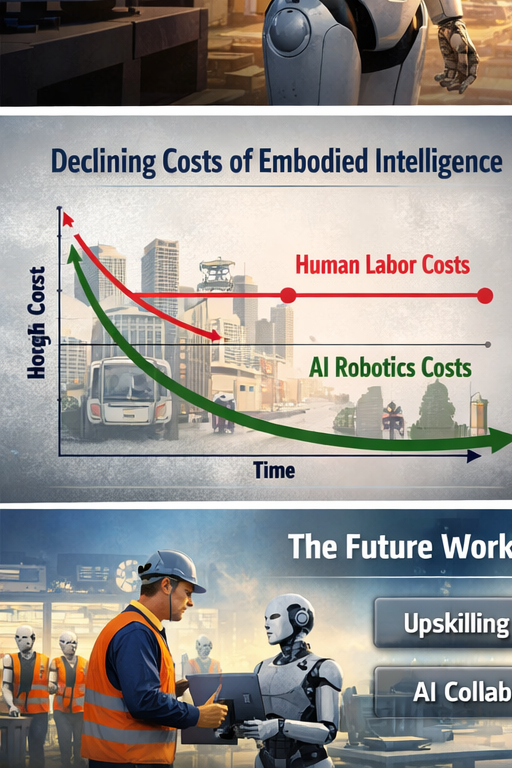
Every major technology that reshaped human productivity followed the same curve: high initial cost, rapid learning, then exponential cost reduction. Computing, cloud infrastructure, smartphones, industrial automation—all were once prohibitively expensive and later became ubiquitous.
Embodied intelligence is on the same trajectory.
Today, humanoid robots and autonomous systems are still capital-intensive. But hardware costs are already declining due to: • Advances in actuators and sensors • Standardization of robotic platforms • Mass manufacturing by Chinese and global supply chains • Modular robotic components replacing custom designs
At the same time, software leverage is increasing. Once trained, a robot model can be deployed infinitely at near-zero marginal cost—unlike human labor, which scales linearly.
Over the next decade, the total cost of ownership (TCO) of embodied systems will fall below human labor in many sectors, especially in: • Warehousing and logistics • Manufacturing and assembly • Food processing and packaging • Elder care and facility operations
This is not a speculative claim. It is the same economic logic that drove cloud computing to replace on-prem servers and automation to replace manual production lines.
 Energy Is a Solvable Constraint, Not a Bottleneck
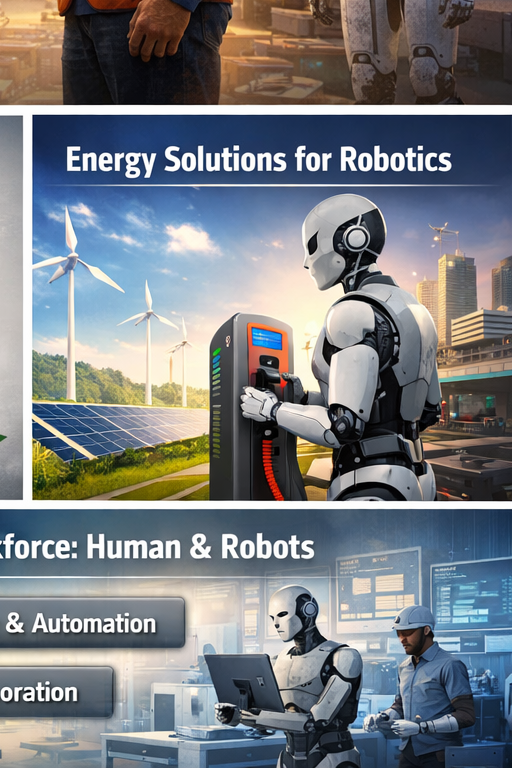
One of the most common objections to large-scale robotics is energy consumption. But energy is not the limiting factor—labor is.
The world is already transitioning toward: • Distributed renewable energy • On-site solar + battery systems • Smart grids and energy optimization • Electrification of industrial processes
Robots consume electricity. Humans consume energy too—just in biological form, with significantly lower efficiency and higher unpredictability.
In fact, embodied systems are more energy-efficient per unit of output: • They do not require heating/cooling environments • They can operate in darkness, cold, or hazardous conditions • They optimize motion and task execution mathematically • They can be scheduled during off-peak energy hours
As energy becomes cheaper, greener, and more decentralized, it becomes an enabler of embodied intelligence, not a constraint.
⸻
Intelligence Models Will Improve Faster Than Humans Can Train
Human labor improves linearly. AI improves exponentially.
Large language models, vision models, reinforcement learning systems, and multimodal policies are advancing at unprecedented speed. Every generation of models learns from: • Massive real-world datasets • Simulation environments • Teleoperation and imitation learning • Cross-domain generalization
Embodied intelligence systems benefit from: • Shared learning across fleets • Continuous self-optimization • Instant skill replication • Zero forgetting
A human worker takes years to train and can transfer knowledge to a few colleagues. A robot learns once and transfers to millions.
This creates a fundamental asymmetry: Human intelligence is localized. Embodied AI intelligence is global and compounding.
In a labor-constrained world, this is the only intelligence model that scales.
⸻
Regulation and Policy Will Open the Door—Not Block It
Historically, regulation lags technology. But in the case of labor shortages, governments are aligned with automation—not against it.
When societies face: • Healthcare worker shortages • Aging populations • Infrastructure backlogs • Manufacturing reshoring pressure
Regulators do not ask how to slow automation. They ask how to enable it safely.
We are already seeing: • Autonomous vehicle pilot zones • Robotics-friendly industrial policies • AI safety frameworks instead of bans • Government-funded automation programs • Workforce + robotics hybrid standards
In Japan, South Korea, Germany, and China, robotics is officially positioned as a national productivity strategy.
The U.S. will follow the same path—not because of ideology, but because there is no alternative.
You cannot regulate demographics.
⸻
User Acceptance Will Follow Economic Necessity
The final and most underestimated factor is user acceptance.
People do not adopt technology because they love it. They adopt it because they need it.
Nobody wanted: • Self-checkout machines • Online banking • Remote work • Autonomous recommendation systems
They became normal because the system demanded them.
As labor becomes scarce: • Businesses will accept robots to survive • Consumers will accept robots to maintain services • Governments will accept robots to sustain growth
Acceptance is not psychological. It is economic inevitability.
When restaurants cannot hire staff, when warehouses cannot fulfill orders, when hospitals cannot find nurses—robots are no longer “cool technology.”
They become infrastructure.
⸻
The First Technology Designed for a Post-Labor Economy
Embodied intelligence is not just another automation wave. It is the first technology designed for a world where: • Labor is structurally scarce • Populations are aging • Productivity must grow without people • Intelligence must scale independently of humans
Every previous industrial revolution assumed infinite labor. This one assumes the opposite.
That is why embodied intelligence is not one solution among many.
It is the only solution that matches the physics of the problem.
Not software. Not outsourcing. Not education. Not policy.
Only intelligence that can physically act in the real world—at machine scale—can replace labor at human scale.
This is not about replacing humans. It is about preserving civilization under demographic constraints.
And embodied intelligence is the only system capable of doing that.